Sam’s Tailor was founded in 1957 by Narindas Melwani, a young tailor who had arrived in Hong Kong from India. The business began the way many of Hong Kong’s most enduring companies began: with a contract to produce uniforms for British soldiers stationed in the colony. That first contract did three things at once. It gave Narindas a steady income. It forced a standard of technical quality that institutional clients demand. And it built the operational infrastructure — cutting rooms, fitting rooms, a roster of cutters and machinists — that would later be used to serve a very different kind of customer.
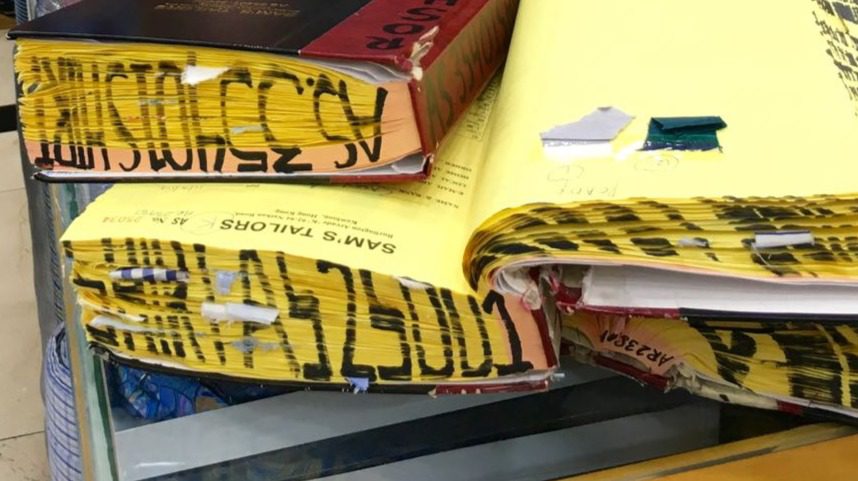
Generations of customers can be found in our measurement books
Read More
The shop that became Sam’s Tailor opened on the ground floor of the Burlington Arcade on Nathan Road, Tsim Sha Tsui. From the start, the business traded on three things: precision of cut, accuracy of measurement, and a refusal to rush a fitting. A suit that left the shop was expected to be worn — and to be remembered.
Hong Kong in the late 1950s and 1960s was a port city full of businessmen, diplomats, visiting executives, and — as the city became a film and entertainment hub — performers. Sam’s Tailor suited them all. By the time Narindas brought his sons into the business, the client book already included British colonial officials, visiting American executives, and a steady stream of stage and screen names passing through Hong Kong. The Hong Kong Tourism Board would later list the shop as a recommended experience. Word of mouth among business travellers did the rest.
Narindas Melwani died in 2016, by which point the business he founded was well into its third generation and beginning the social media transformation that would redefine its external profile without changing the product underneath. He did not get to see the TikTok era. But he built the foundation that made all of it possible.
The Second Generation: Manu and Sham
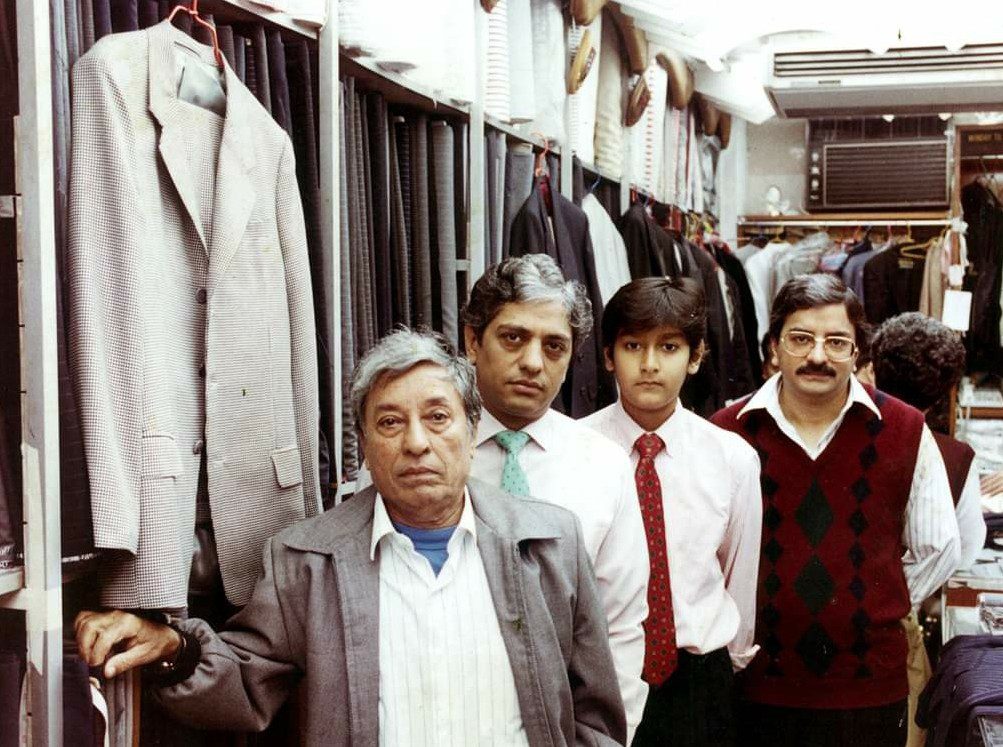
Sam’s Tailor, Three generations: Narindas, Manu, Roshan, Sham (left to right)
Narindas brought his two sons into the business at a young age — not as a formal apprenticeship, but as a gradual absorption of skills, standards, and values through proximity and repetition. They grew up in the fitting rooms and cutting rooms, watching their father work, learning the distinction between a suit that is technically correct and a suit that is right for the person wearing it.
The division of labour between the brothers emerged organically from their respective strengths.
Manu Melwani handles the client-facing side of the business: the consultation, the fitting meetings, the relationship with clients over years and in some cases decades. As a young man, he went to train in Saville Row, and till this day continues to uphold that craft and service ethic as a core pillar of the business. He has been doing this since before most of the clients whose photographs line the walls of the Burlington Arcade shop were born.
In 2022, Manu was awarded the MBE at Windsor Castle by Prince William — recognition from the British state for decades of service to the craft of bespoke tailoring, and specifically for the sustained practice of the trade rather than the celebrity work that dominates the press coverage. He went to Windsor, received the medal, and came back to the shop on Nathan Road the next day.
Sham Melwani works in the back room — literally and figuratively. A master cutter in the Savile Row tradition understands that the cutter reads the body, interprets the client’s needs, translates both into a paper pattern, and ensures that what gets made is exactly what was intended. Sham has been doing this for longer than most of the cutters working in Hong Kong bespoke have been alive. The “Sam” in Sam’s Tailor is sometimes credited to his name — the English version that early British clients could pronounce.
The Craft, Passed Down
The Melwani technique was never advertised as a “house style.” It was passed hand-to-hand, fitting room to cutting table, father to son. Three generations of the same family, working on the same wooden-block shop floor in the Burlington Arcade, is unusual in any trade. In bespoke tailoring, where most houses last one or two generations, it is exceptional.
The shop’s signature is a tight, conservative cut with sharp shoulders and a high armhole — the look that has made the Sam’s Tailor name famous on red carpets from Hong Kong to Hollywood. Clients who have worn the work include Kylie Minogue, Naomi Campbell, David Bowie, Mick Jagger, Bill Clinton, George H.W. Bush, and King Charles III, among many others. The shop is reported to have dressed five American presidents in total, two British prime ministers.
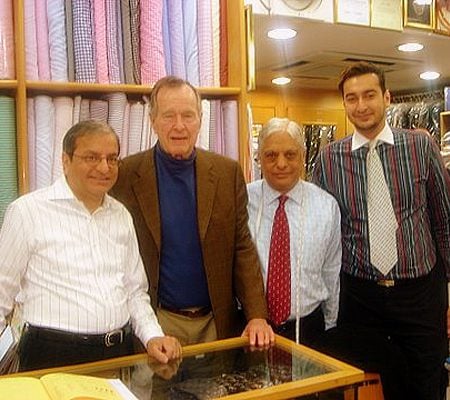
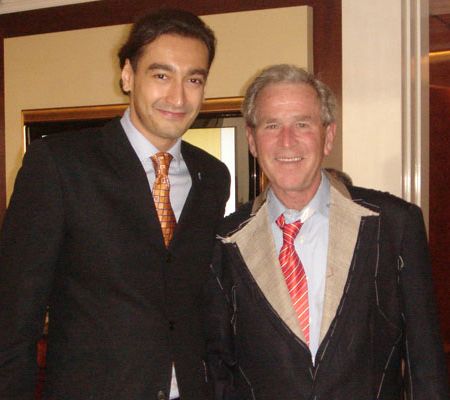
George Bush both generations, both clients
What is being passed down is not just the cut. It is a workflow. A new client at Sam’s Tailor is still measured standing, sitting, and walking. The pattern is still drafted by hand on brown paper. The first fitting is still basted — temporary stitches that allow for adjustment — rather than machined. The final fitting is still done by Manu or Roshan personally, not by an assistant.
The Third Generation: Roshan and the Digital Pivot
Roshan Melwani, the third generation, took the business in a direction that the first two did not: a deliberate move into social media. The pivot started by accident, and then it worked.
When COVID-19 emptied Hong Kong’s streets in early 2020, Roshan did what most luxury houses did not: he picked up a phone and started live-streaming. The empty shop became a stage. He streamed fittings, fabric selections, and Q&As from the Burlington Arcade showroom in Tsim Sha Tsui. There was no script, no studio lighting, no production team — just a tailor, a phone on a tripod, and an audience that had been locked indoors for weeks.
It worked. Viewers started ordering suits through the streams. A client in London could send measurements by WhatsApp, watch Roshan select the fabric on a live feed, and have a finished suit shipped inside a month. The stream also let prospective clients see the back of the house — the cutting table, the pressing station, the rolls of cloth — for the first time. A craft that had lived behind a closed door for sixty years was suddenly on camera.
In 2023, Roshan launched a TikTok channel and a more structured Instagram Reels series, packaging the same content into 60-second “suit snippets” — a measuring tape unspooling, a shears cutting a chalk line, a finished jacket on a mannequin. The South China Morning Post profiled him that July under the headline “How Sam’s Tailor heir in Hong Kong is using TikTok and Instagram to make suits ‘cool for kids’, after dressing US presidents George H.W. Bush and Bill Clinton.” The Beijing Times called him the “Suit Whisperer of Hong Kong.”
The strategy was not just visibility. It was customer acquisition. Before the live-streams, Sam’s Tailor’s client base was overwhelmingly walk-in, word-of-mouth, and repeat. After 2020, a meaningful slice of new orders came from viewers who had never set foot in Hong Kong. The shop’s geographic reach expanded from a one-kilometre radius around Tsim Sha Tsui to a global mailing list.
Roshan has become an online legend in his own right, bring the Saville Row craft to a whole new generation
Why the Move Matters for Bespoke
Roshan’s social-media work is not a side project. It is a continuation, in a different medium, of what his grandfather and father did in person. Three shifts stand out.
The first is transparency. The livestreams show the cutting table, the fitting room, the hand-finishing. For a craft whose value has always been its invisibility — a bespoke suit is, by definition, a private transaction — that visibility is a real change. It also creates accountability. A tailor who has shown his stitching on camera is held, by his audience, to that standard.
The second is a new customer base. TikTok and Instagram Reels have brought a younger, global audience into the shop’s orbit. These are viewers who would never have walked into Burlington Arcade, who may not have known bespoke tailoring existed outside Savile Row, and who will book a fitting after seeing a 60-second clip.
The third is continuity. The “Digital Bespoke” service lets overseas clients send measurements, approve a digital pattern, and have a Sam’s Tailor suit shipped to them — without ever setting foot in Hong Kong. For a three-generation family shop that has always relied on in-person fittings, the ability to serve a client in São Paulo or Seoul is, in commercial terms, a new business model built on a 70-year-old craft.
The risk is real too. Bespoke pricing is built on scarcity, and Roshan is, deliberately, making the process less scarce. The bet is that the quality remains scarce, even when the image of the quality becomes abundant.
Frequently Asked Questions
Q: When was Sam’s Tailor founded?
A: 1957, by Narindas “Sam” Melwani in Tsim Sha Tsui, Hong Kong.
Q: Who runs Sam’s Tailor today?
A: The business is now in its third generation. Manu Melwani leads the client-facing work and was awarded the MBE at Windsor Castle in 2022. Sham Melwani is the master cutter. Roshan Melwani leads the digital strategy, social media, and the next generation of the business.
Q: Where is the shop?
A: Burlington Arcade, Nathan Road, Tsim Sha Tsui, Hong Kong.
Q: Who has Sam’s Tailor dressed?
Clients have included British royals (including King Charles III and Queen Elizabeth II), five American presidents (including George H.W. Bush and Bill Clinton), two British prime ministers, and celebrities including Kylie Minogue, Naomi Campbell, David Bowie, and Mick Jagger. Diana, Princess of Wales, was measured at the shop during a Hong Kong visit.
Q: Can you order a suit online?
A: Yes. Sam’s Tailor offers a Digital Bespoke service: clients send measurements and photos, approve a digital pattern, and have a finished suit shipped.
Q: When did Roshan start using social media?
A: The live-streaming strategy, with TikTok and Instagram, began in 2018, and ramped up during COVID-19.
Q: Where does the name “Sam’s Tailor” come from?
A: The “Sam” is a family nickname for Narindas, and the shop’s English name is also sometimes credited to his son Sham, whose name early British customers found easier to pronounce.