Somewhere between booking the venue and arguing about the seating chart, you will find yourself typing wedding suit Hong Kong into your phone late at night, hoping someone on the internet actually knows what they are talking about.
Let me save you the twenty open tabs: the wedding industry is built to sell you a costume for one day. A tailor is built to make you a suit you will still be wearing in twenty years. Those are completely and utterly different products; The difference shows in every single photograph.
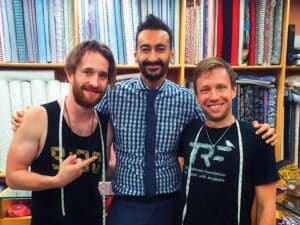
I’m Roshan Melwani. Three generations of my family have been cutting suits at the same address in Tsim Sha Tsui since 1957. This is the guide I would write for a friend before he spent a dollar on his wedding suit — what to order, what it costs, when to start, and the details that decide whether you look like yourself in the photos, or like a rental.
Read On…
The Costume Problem
Here is the math nobody does before they rent. A suit rental runs somewhere between US$150 and $250 per wearer, per event — and at the end of the night, you hand it back. You have paid real money for a garment that was never yours, cut for a body that is not quite yours, and photographed at the exact moment you will look at those pictures for the rest of your life.
The thing you rent is a costume. I don’t mean that as an insult to rental shops; I mean it as a fact about what the product is for. It is for one day. It is priced for one day. It fits like one day.
The alternative is a wedding suit Hong Kong grooms keep wearing: your own pattern cut from scratch, canvassed properly, fitted twice — a garment that does the wedding, then the interviews, the anniversaries, the other weddings. Men are figuring this out: the wedding suit Hong Kong’s tailors build properly outlives every trend in the photographs. The industry’s own research shows the drift: six in ten couples now describe their wedding as semi-formal, against fewer than one in five who go formal or black tie. That drift is your opening. You are allowed to wear a real suit that happens to be your wedding suit, instead of a costume that only works for one evening.
And here is the part that matters in ten years: nobody frames a receipt. A suit that fits right becomes the photograph you actually like — the one from your own wedding, and the one from your daughter’s.
What Grooms Are Actually Ordering in 2026
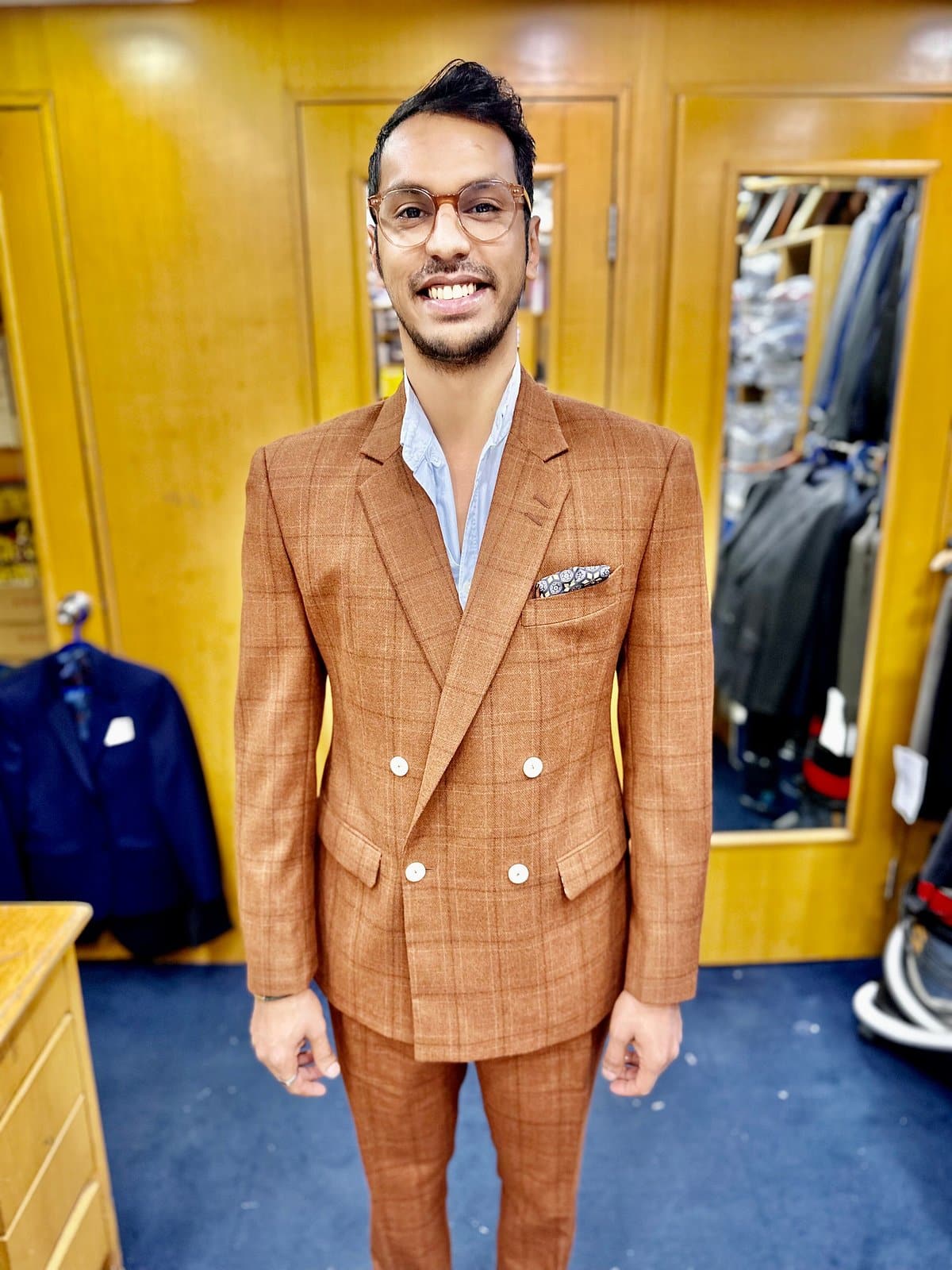
The colors moved this year. Earth tones are taking over from navy and charcoal — terracotta, sage, espresso, warm camel — a shift both Pinterest’s 2026 wedding forecast and the industry’s trend reports have flagged. What that looks like in our shop: more brown than we have cut in decades. Chocolate, tobacco, cognac. Real browns, not the safe caramel of years past. A well-cut brown suit photographs with depth instead of flatness, and it does not disappear at an outdoor ceremony the way a dark navy can.
The three-piece is back. Waistcoats returned in a big way this year — partly because a waistcoat lets the groom stand apart without wearing a different suit than his party. And the party itself has loosened up: matching uniforms are out, tonal coordination is in. Same family of color, different textures, each man looking deliberate rather than identical.
The shirt is changing too. White is no longer the automatic choice; cream, dusty blue and muted taupe are showing up under these suits, usually with a tie in the same family.
Then there is the factor the trend reports never account for: humidity. A wedding suit Hong Kong summers will actually test has to survive a thirty-degree evening of standing, photographs and dancing. Cloth choice matters more than color here — mid-weight high-twist wools that breathe and recover, porous weaves over dense flannels, lining decisions that keep you cool. I will steer you away from anything that looks great on a mood board and behaves badly in July. The fabric has to live in this city, not just in the pictures.
Black Tie or Not: The Tuxedo Question
The tuxedo is the most romantic purchase in menswear, and for most grooms a wedding suit Hong Kong can build for the same money is the better buy. The numbers have been moving away from black tie for years: one analysis of 6,500 wedding commissions at a Sydney bespoke house found tuxedos at under 4% of orders, with black-tie dress codes down to 6% of weddings while cocktail attire climbed to 45%. The wedding industry’s own research says the same thing — most couples now call their wedding semi-formal, and fewer than one in five go full formal.
Here is why that is good news. A midnight-blue or charcoal suit does everything a tuxedo does at a semi-formal wedding, and then it keeps working. A tuxedo is a one-day costume by design — satin, bow tie, patent shoes, and nowhere to wear it again until somebody else gets married. A beautifully cut dark suit with peak lapels reads just as sharp at night, photographs beautifully under warm light, and on Monday it goes back to being your best suit.
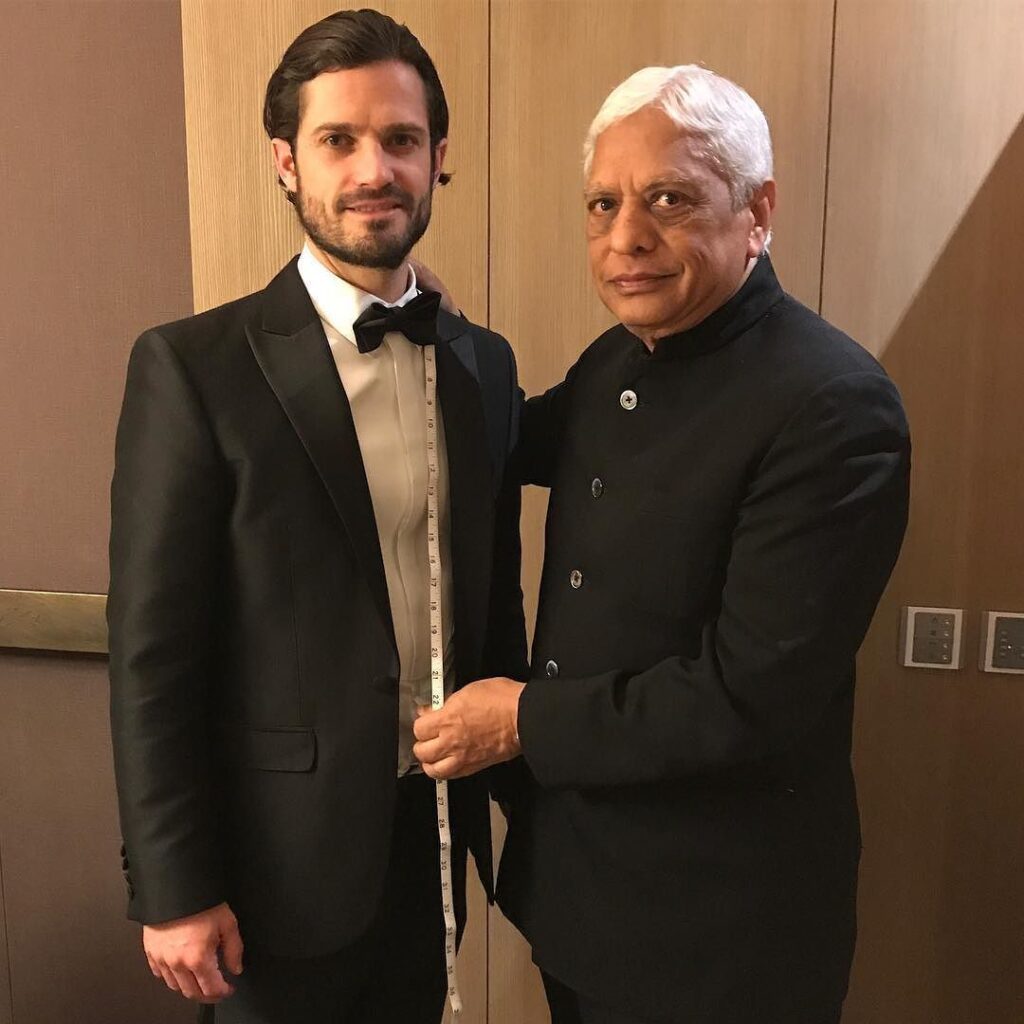
The Prince of Denmark fitted for formal wear at Sam’s
Order the tuxedo if — and this is a real if — your venue is genuinely formal, the dress code says black tie, and you will attend black-tie events again. Otherwise, put the tuxedo money into the suit you will wear for a decade. And if the invitation says “cocktail”, relax: that is a suit-and-tie evening, which is exactly what we are building here.
The Timeline (and Why it isn’t 24 Hours)
Start three to four months before the wedding if you can — that is the advice every planner gives, and it is right. But here is the honest version for Hong Kong: we can deliver a finished wedding suit in two to three weeks with two fittings, and if your wedding is close, come in and we will tell you straight what is possible.
What I will not do is build your wedding suit in twenty-four hours. I wrote a whole piece about why the 24-hour suit exists and when it makes sense — read it — but weddings are not the job for it. You will be photographed from angles you did not agree to, by relatives with no mercy, and the suit has to hold up across a long day: standing, sitting, dancing, toasts, humidity. A compressed schedule skips refinement, and refinement is exactly what you are paying a tailor for at a wedding.
Two fittings is the standard rhythm. The first is the basted fitting — the suit comes together loosely, chalk marks everywhere, and we adjust the balance, the shoulder, the way the sleeve sits when your arm is actually at your side. The second is the near-finished fitting a couple of weeks later: sleeve length, trouser break, button stance. If you are losing weight before the wedding — plenty of grooms are — tell us at the start. We will cut for the man in front of us and plan the final fitting for two to three weeks before the day.
Book now, not because of scarcity, but because a calm fitting schedule is a better fitting schedule. Wedding season runs through autumn and spring in this city, and the good slots go first. A wedding suit that will be photographed for fifty years deserves the full calendar.
What It Costs
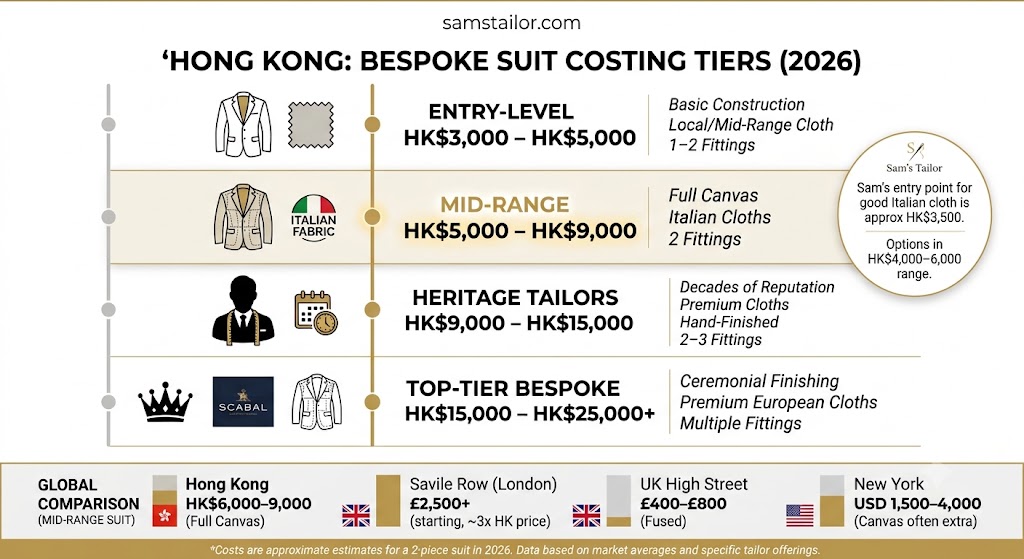
A two-piece suit at Sam’s starts from about US$540 — HK$3,500 — in good cloth. Most first-time clients land in the HK$4,000–6,000 band with a mid-range Italian cloth like Vitale Barberis Canonico. A waistcoat adds roughly HK$1,500–3,000, which is why the three-piece decision is also a budget decision. Heritage cloths go higher; the ceiling depends on the bolt you fall in love with.
What drives the price, honestly: the cloth, the construction — full canvas, hand-finished details — and the time of the people who do the work. What it does not include is a label tax. You are not paying for a brand’s campaign; you are paying for a workshop of more than fifty people whose only product is fit.
Compare that to the rental math from earlier — US$150–250 per wearer for one evening, gone by Monday — and the cost-per-wear argument takes care of itself. A wedding suit Hong Kong men own gets worn to the wedding, then to every wedding after it, then to the office on the days that matter. Divide the price by twenty years and it stops being an expense.
One more honest note: peak-season rush jobs cost more, and I will not pretend otherwise. The difference is that our queue is one you can see, in a workshop you can walk into.
The Details That Photograph
A wedding suit Hong Kong grooms regret is almost always one where these four details never came up. Tell your tailor the whole truth up front: the venue, the time of day, indoor or outdoor, and how your photographer works — all four change the recommendation. A midday garden ceremony and a candlelit ballroom want different cloths; a photographer shooting candid black-and-white will see your suit differently than one shooting warm editorial color.
The details that matter most in photographs:
The shoulder and collar. Everything in a jacket’s photograph flows from the shoulder. This is why the basted fitting exists, and why we spend most of the first fitting reading how you actually stand.
The lapel buttonhole. Ask for a real, working one. A pinned boutonniere sits wrong all day; a buttonhole holds the flower exactly where it should sit, and it reads at close range in portraits.
The waistcoat. The cleanest way to stand apart from your groomsmen without wearing a different suit than they are. It also solves the jacket-off problem at the reception.
The shirt collar. A spread or semi-spread collar frames the tie knot and stays crisp through the day. For a relaxed outdoor wedding, an open collar with a good roll beats a wilting tie.
The shoes. Brown with earth tones — black shoes fight warm colors. And skip the belt: suspenders hold the trouser line cleaner, and nothing breaks the vertical line of the suit.
The pocket square. Subtle, in the same family as the tie, never matching it exactly.
And one thing not to do: don’t match the groomsmen exactly. The tonal look — same palette, different textures — is what the well-dressed parties are doing right now, and it photographs better because nobody reads as a backup dancer.
Frequently Asked Questions (FAQs)
Q: How much does a wedding suit in Hong Kong cost at Sam’s Tailor?
A: A two-piece starts from about US$540 (HK$3,500) in good cloth; most grooms land in the HK$4,000–6,000 band with a mid-range Italian cloth — the standard wedding suit Hong Kong clients take away. A waistcoat adds roughly HK$1,500–3,000. The full price picture is in our cost guide, linked below.
Q: How long does it take to get a wedding suit made?
A: Two to three weeks with two fittings is our standard rhythm, and we recommend starting three to four months before the wedding so the wedding suit Hong Kong builds for you is never rushed. Peak season — autumn and spring — books up first. We can work tighter than three weeks if we must; we will tell you honestly on the day.
Q: Can you make my wedding suit if I’m getting married overseas?
A: Yes — plenty of our grooms are destination or diaspora clients. We take measurements in person when you pass through Hong Kong, or remotely through our Digital Bespoke service, and ship the finished suit to you. Your pattern stays on file for life, so reorders happen without a refitting.
Q: I’m planning to lose weight before the wedding. What do I do?
A: Tell us at the first fitting. We will cut for the man in front of us and plan the final fitting for two to three weeks before the day, when your shape is closest to what it will be. Small changes after that are normal and included; large ones are a conversation, not a crisis.
Q: It’s a summer wedding in Hong Kong. What fabric should I choose?
A: Mid-weight high-twist wools and porous weaves — the right wedding suit Hong Kong summer cloth: it breathes, recovers, and does not wilt in a thirty-degree evening. We will steer you away from anything too dense for this climate, however good it looks on a swatch. This is the single most common mistake visitors make.
Q: Tuxedo or suit — final answer?
A: If the dress code says black tie and you will wear it again, tuxedo. Otherwise, a midnight-blue or charcoal suit with peak lapels gives you the same evening presence and a decade of Mondays. For most grooms reading this, a wedding suit Hong Kong delivers the same evening — and keeps working after.
Q: Do I need a waistcoat?
A: Not strictly — but it is the easiest upgrade in wedding tailoring. It separates you from the party in photographs, keeps you looking finished when the jacket comes off, and adds a layer of formality that photographs well. If the budget allows one flourish, make it this one.
Related Content
Hong Kong: How much does a bespoke suit cost?
The full 2026 price picture, tier by tier, from entry cloth to heritage finishing.
The 24-Hour Suit: How Hong Kong’s Fastest Tailor Actually Does It
The express service, explained honestly — including when not to order one.