What the Hong Kong Tailor Actually Sees
“Every season, the magazines tell men what’s in. Every week, I tell them what’s true.”
Roshan Melwani
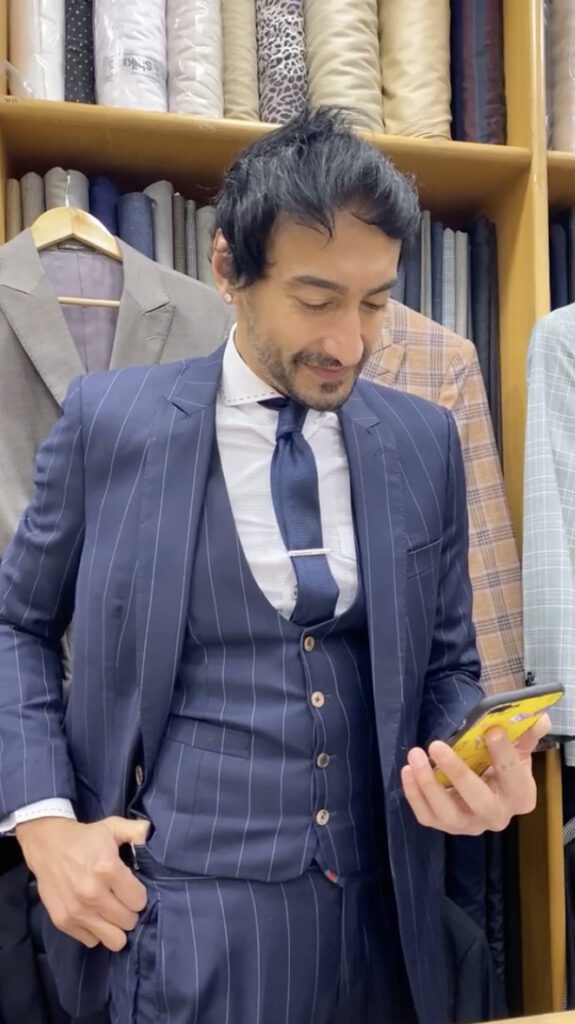
Roshan Melwani keeps his finger on the pulse of fashion, whilst knowing what is classically true in Tailoring
Quick Read
I want to tell you what I actually see when men walk through my door in 2026. Not what the fashion magazines say is in — what they’re actually wearing, what they’re asking for, what changes and what doesn’t. After fifty years of doing this, you develop a sense for when something is a real shift and when it’s just noise. Let me show you what’s real. The most significant thing I’ve noticed isn’t a trend — it’s a correction.
The men who are still wearing suits regularly are the ones who actually want to wear them. During the pandemic, a lot of men discovered they didn’t have to wear suits every day, and a lot of those men made peace with that decision. What that means is: the men walking into my shop now are the ones who care. They’ve self-selected. They’re harder to impress, they notice details, and they’ve usually done some research before they arrive. I find that refreshing. It makes for a better conversation. What are those men actually buying? Navy — but darker, more considered, moving toward midnight rather than the mid-navy we saw everywhere in the 2010s.
Brown is having a genuine moment, and I mean the real brown — chocolate, tobacco, cognac — not the lighter caramel that used to be the entry-level option. Grey has had its decade and it’s over. Slim fit has given way to something that actually fits. And pattern is coming back — windowpane checks, subtle herringbone, the kind of texture that does a lot of work without shouting. The basics still hold. But the men asking for the basics are paying more attention than they used to.
Read More
The Gap Between What’s In and What’s Good
Every January, the fashion press publishes its trend forecasts. Every February, the bespoke tailoring industry watches men walk in wearing whatever those trends said was “in” — and proceeds to explain why the trend was wrong.
This is not a new observation. It is also not a cynical one. The fashion industry’s job is to sell clothing. The bespoke tailor’s job is to sell fit. These are different objectives and they do not always align.
What follows is not a trend forecast. It is an account of what a Hong Kong tailor actually sees when men come through the door in 2026 — what’s changed, what hasn’t, and what the gap between the two tells us.
The Post-Pandemic Fit Correction
The most significant shift of the past three years is not a trend in the fashion sense. It’s a correction.
During the pandemic, men who had been wearing suits every day discovered that they didn’t have to. Many of them stopped. Some of them haven’t gone back to daily tailoring. The men who are still wearing suits — regularly, not just for weddings and job interviews — are by and large the men who actually want to wear suits.
This sounds obvious. It isn’t. What it means is that the baseline of expectation has shifted. The market is self-selecting. The men walking into tailors in 2026 are, more than at any point in the past decade, the men who actually care about how a suit fits. They are harder to impress. They notice details. They have usually done some research before they walk in.
That’s a good thing for a tailor. It’s a more interesting conversation.
Roshan Melwani is also an expert in Women’s Fashion
Colour: The Navy Situation
Navy blue remains the default. It will probably always be the default. There is nothing wrong with navy. A well-cut navy suit is one of the most useful garments a man can own.
But 2026 is showing something more specific in the blues: a move toward darker, more saturated navy — not midnight, but closer to it than the mid-navy that dominated the 2010s. The lighter, more summery navy that was everywhere five years ago has faded. The direction is depth.
What this tells us: men are still buying suits for versatility (the navy-can-wear-it-anywhere logic remains sound). But they want that versatility to feel more intentional. A darker navy reads as more considered. It looks better with a white shirt and it looks better with a pale blue shirt and it looks better in the evening than it did when the default was a slightly brighter blue.
We’re also seeing more interest in texture — a navy with a subtle windowpane or micro-herringbone reads as more sophisticated than flat navy at the same price point. Texture does a lot of work.
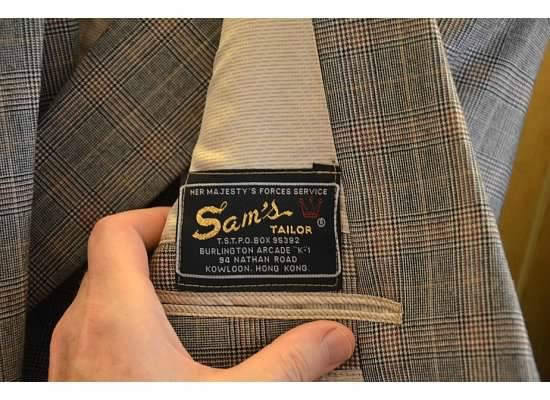
We have always loved textured fabrics at Sam’s
Brown Is Having a Moment. Finally.
Brown suits have been “coming back” for about eight years. In 2026, they’re actually here.
The brown we’re seeing is predominantly mid-brown to dark brown — chocolate, tobacco, cognac. The lighter caramel tones that were the ” entry level” brown suit option have been supplemented by something more serious. Men are pairing brown suits with white shirts, with cream shirts, with pale blue shirts. The combinations that used to feel safe now feel intentional.
The brown trend has a specific character: it is less formal than navy but more interesting. It works for the man who has a navy suit and wants something that does a different job. It does not replace navy — it sits alongside it.
What we’re not seeing much of: grey. The decade of grey has ended. Not dramatically — grey isn’t dead — but it has lost its dominance. The men who come in asking about grey are now the exception rather than the default first question.
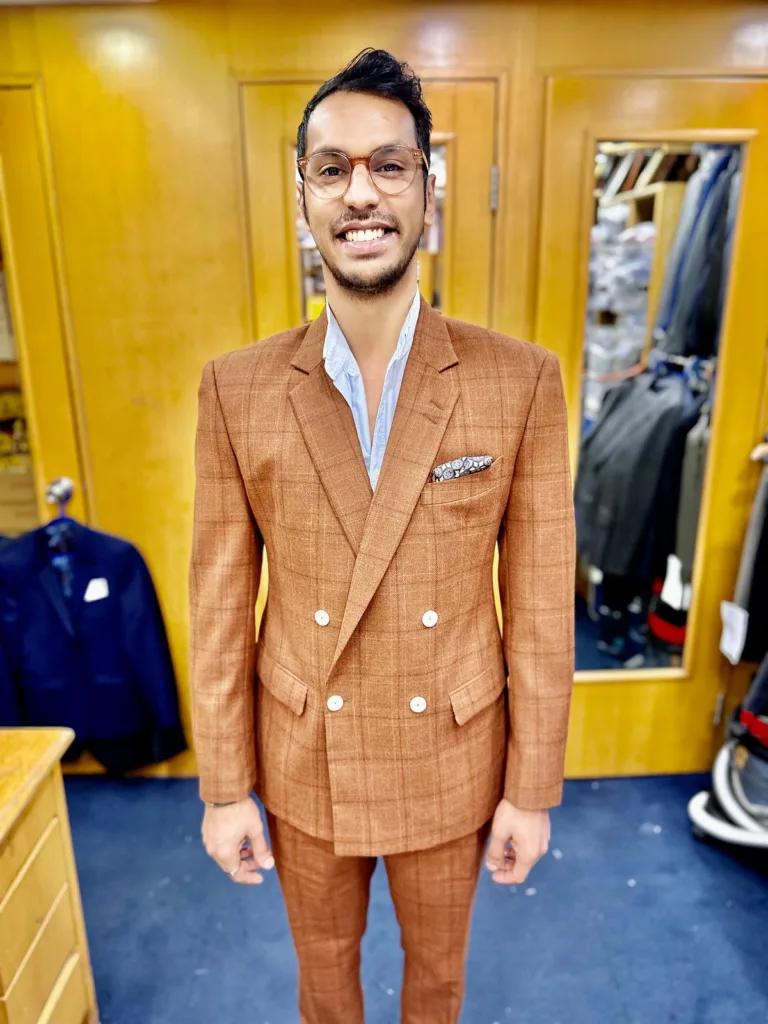
Here’s what you and Roshan can do with interesting shades and textures
The Slim Fit Question
The era of the extremely slim suit is over. Not in the sense that slim suits are no longer being made — they are, in enormous quantities, by every fast fashion brand and most mid-market menswear labels. But the cultural cachet of “as slim as possible” has diminished significantly.
What has replaced it: a more considered approach to silhouette. The men coming in are asking for a suit that fits properly — which means something that follows the shape of the body without being tight, that allows movement, that doesn’t require the wearer to hold their breath.
The technical word for this is “half-canvas, with a moderate suppression.” The non-technical word is “a suit that actually fits.” That sounds simple. It is simple. It is also surprisingly rare.
The shift away from extreme slimness is also a shift away from the “I want to look like I haven’t eaten” school of tailoring. Men want to look like they have a body. The jacket should suggest the body’s shape rather than compressing it into something that looks good in a photograph and uncomfortable in real life.
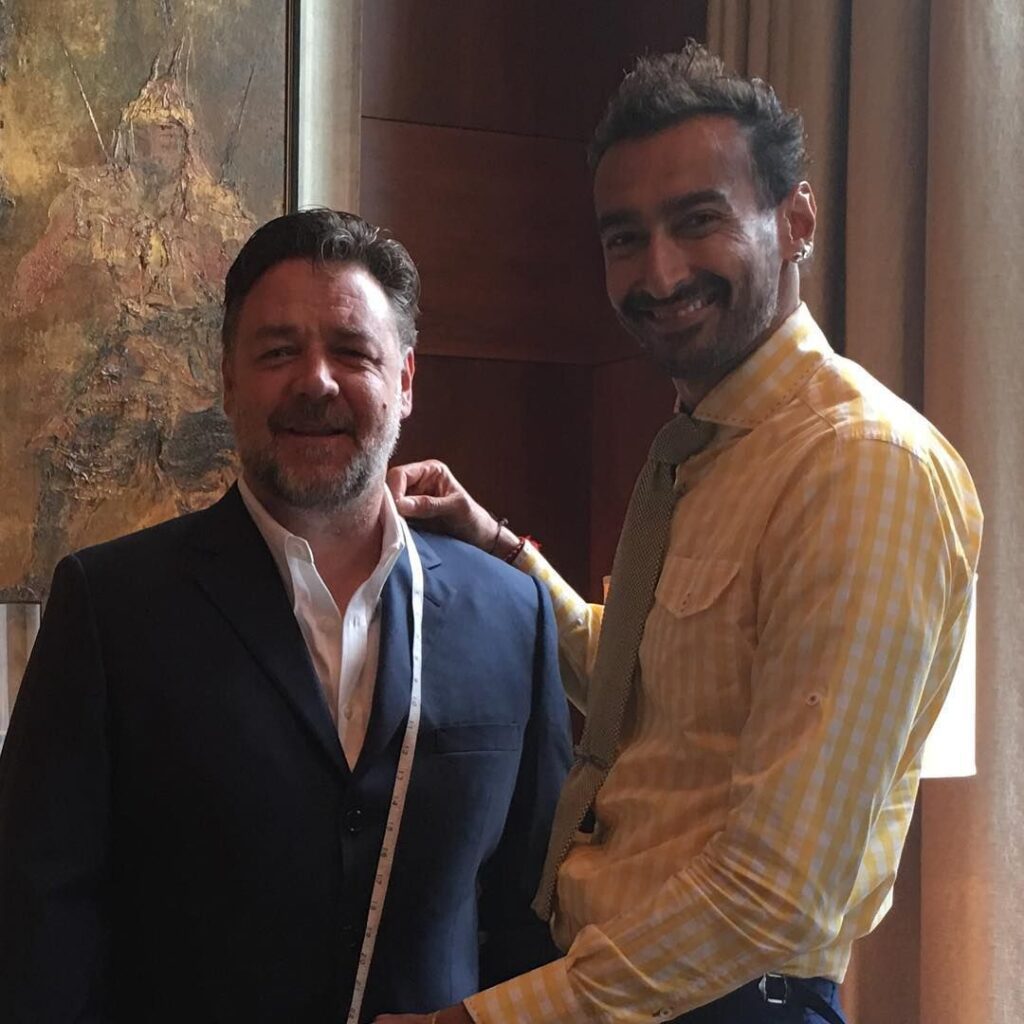
Dressing for a strong frame is back, as the emphasis shifts to a look that is actually correctly tailored.
Statement Fabrics: The Return of Pattern
Plain fabrics dominated the 2010s and held strong through the early 2020s. In 2026, we’re seeing pattern come back — not aggressively, but noticeably.
Windowpane checks are the entry point. A grey suit with a subtle windowpane is less formal than the equivalent plain grey and reads as more considered than a plain suit. It is a pattern that men who have never worn pattern are willing to try.
Beyond windowpane: the bolder checks are coming back, more tentatively. A chalk stripe is not for everyone, but the men who want one are increasingly confident about asking for it rather than hedging.
The pattern return is a signal of something broader: men are getting more experimental, more willing to have a point of view about what they’re wearing. The default — plain navy or plain grey — is still the default. But there is a growing group of men who want something more specific.
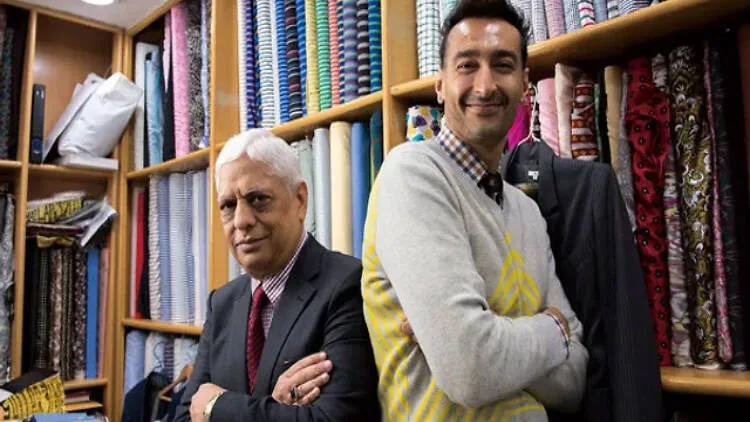
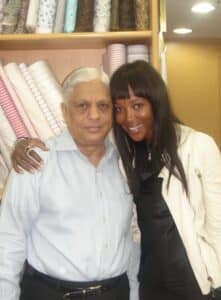
A love of interesting fabrics has passed down through the generations
The Wedding Suit Situation
Wedding suits are a category of their own and 2026 is producing some specific patterns.
The three-piece suit is back — not everywhere, but noticeably. Men who are getting married want to wear something that feels like an occasion, and the three-piece suit does that in a way that a two-piece doesn’t quite manage. The waistcoat adds a level of formality and specificity that works well for photographs and feels different from what the guests are wearing.
The color story for weddings is broader than it used to be. The classic black or charcoal wedding suit is still common, but we’re seeing more navy (darker navy, as discussed), more brown, and — increasingly — mid-blue. The “something blue” tradition is being interpreted literally in some cases. A mid-blue suit for a wedding is specific and memorable and photographs well.
The alternative to the classic wedding suit — a more fashion-forward cut, perhaps with a double-breasted jacket or a less conventional color — is still a minority choice, but the men making that choice are more informed than the equivalent group five years ago. They know what they want and they’ve usually seen enough examples to know what they’re asking for.
The Bespoke/ Made To Measure Divide
Here’s the trend that doesn’t get written about in the fashion press because it is boring and structural rather than visual:
More men are understanding the difference between bespoke and made-to-measure.
This is not universal. Most men who walk in still use the terms interchangeably. But the percentage who understand the distinction — who know that bespoke means a pattern cut from scratch for their body, that made-to-measure means an existing pattern adjusted — has increased noticeably over the past two or three years.
What drives this understanding is largely social media. The conversations about tailoring that happen on TikTok and YouTube have educated a generation of men about the difference between “a tailored suit” and “a suit that was technically made for you.”
This is good for bespoke. It is also challenging for made-to-measure — because once you understand the difference, you can feel the difference. The men who have done the research and then try both usually prefer bespoke. The men who haven’t done the research yet are the made-to-measure market.
The trend line favours bespoke. The education is happening faster than it used to.
Roshan on how rare truly experienced Tailors are now, despite the increased attention given to fit by clients.
What This Means for Getting a Suit in 2026
It means the basics still work: navy, a good cut, proper fit, a shirt that contrasts. That’s still the foundation and it always will be.
It means the details are getting more attention: the texture of the fabric, the depth of the color, the specific character of the lapel. The men who care are caring more.
It means the conversation with a tailor is better than it used to be. The men who walk in have usually seen enough content to know what questions to ask. They’re not starting from zero.
And it means that the basics — fit, fabric, construction — matter more, not less, as the options proliferate. A well-cut plain suit in a good fabric will always look better than a poorly-cut interesting suit. The trend is toward more considered choices, not toward novelty for its own sake.
The Hong Kong tailor’s perspective is simple: come in, tell us what you need the suit to do, and let us show you what that looks like when it’s done properly. The trends are interesting to track. The suit is what matters.
Frequently Asked Questions
Q: What suit colors are in style in 2026?
A: Darker navy — closer to midnight than the mid-navy of the 2010s — is the dominant direction in 2026. Brown is having a genuine moment, particularly mid-brown to dark chocolate. Grey has lost its decade-long dominance and is no longer the default choice.
Q: Is slim fit over in 2026?
A: The era of extremely slim suits is over. The direction in 2026 is toward a more considered silhouette — a jacket that follows the body’s shape without compressing it. The standard is proper fit, not artificially tight styling.
Q: How much does a bespoke suit cost in 2026?
A: In Hong Kong, fully bespoke suits start at $540 all-in. In London, comparable bespoke work on Savile Row starts at £3,000. The price gap reflects business model differences — heritage branding versus craft-focused pricing — not quality differences.
Q: Are three-piece suits back in 2026?
A: Yes. The three-piece suit is noticeably returning, particularly for weddings and formal occasions. Men who want a suit that photographs well and feels like an occasion are choosing waistcoats to achieve the effect. The three-piece does more work than a two-piece for special events.
Q: What’s the best suit fabric for hot weather?
A: Linen, tropical wool, and cotton blends are the practical choices for hot climates. For Hong Kong’s humidity, a half-canvas construction with partial lining allows the garment to breathe while maintaining structure. Sam’s Tailor advises on cloth selection as part of every consultation.